Best Exterior Paint for Arizona Heat: What Professionals Recommend
Discover which exterior paint brands and types perform best in Arizona's extreme heat and UV exposure. Expert recommendations from Phoenix painters.
John Claude Painting
Family-owned Phoenix painting since 2005
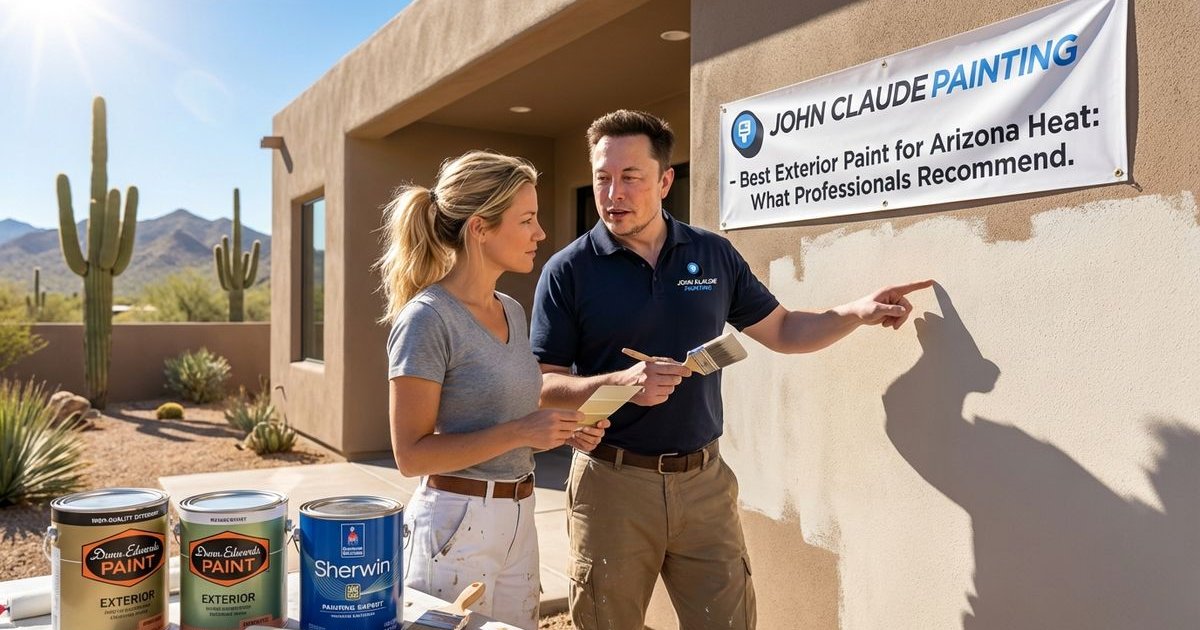
Arizona’s extreme climate is brutal on exterior paint. Intense UV radiation, temperatures exceeding 115°F, and dramatic temperature swings between day and night create conditions that quickly destroy inferior paint. After 20 years of exterior painting in the Phoenix area, we’ve learned which products stand up to our desert climate.
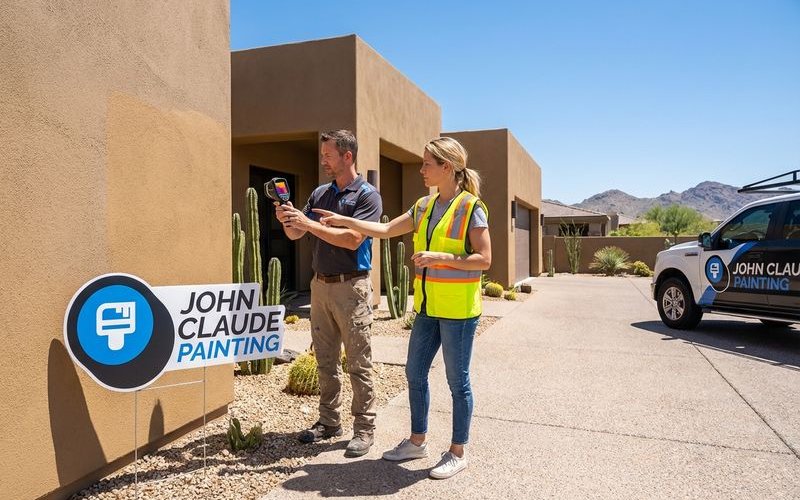
The Reality of Painting in the “Heat Dome”
The heat in the Valley has reached unprecedented levels. The summer of 2024 broke records with 113 consecutive days over 100°F, pushing exterior building materials to their breaking point. Standard “big box” paints that work in the Midwest often fail here within 24 months.
As John Claude Painting AZ, we have seen first-hand what happens when you cut corners on product quality in this environment. The breakdown isn’t gradual; it’s a rapid failure of the chemical bond between the paint and your stucco.
We’re going to break down the exact products that survive these conditions and explain the technical reasons why they work. Let’s look at the data, the specific chemical differences, and the application methods that make the difference between a 3-year paint job and a 15-year investment.
What Arizona Conditions Demand
Extreme UV Exposure
Phoenix receives some of the highest UV radiation indices in the world, often hitting 11+ on the index scale. Paint must resist:
- Binder Degradation: UV rays attack the resin (the “glue”) in paint, causing it to powder.
- Color Fading: Certain pigments, especially organic reds and yellows, burn out faster.
- Chalking: This is the white residue you see when you wipe an old wall, signaling the paint film is dead.
Intense Surface Heat
While air temperature might be 115°F, surface temperatures on dark, sun-facing stucco walls often exceed 170°F to 180°F. Paint needs:
- Heat-resistant cross-linking: The chemical bonds must hold firm under baking conditions.
- Flexibility: The coating must expand as the wall heats up without snapping.
- Stability: Cheap resins soften in this heat, trapping dirt permanently.
Temperature Cycling (Thermal Shock)
Our 30-40 degree daily temperature swings cause materials to expand and contract violently. Paint must:
- Remain flexible (elongation) to move with the substrate.
- Maintain adhesion during rapid cooling (monsoon rain hitting hot walls).
- Resist “hairline cracking” which invites water damage.
Monsoon Moisture
Summer monsoons bring sudden, heavy moisture to surfaces that were bone-dry minutes prior. Paint requires:
- Breathability (Permeability): Moisture trapped inside the wall must be able to escape as vapor, or it will blister the paint off.
- Alkali Resistance: Wet stucco releases high-pH salts that burn through standard primers.
- Mold and mildew resistance: Even in the desert, shaded north-facing walls are prone to growth during humid Augusts.
Top Paint Brands for Arizona Exteriors
We have tested dozens of products, but these three consistently perform best in the Phoenix metro area.
Paint Performance Comparison
| Product | Best For | Volume Solids (Approx) | Est. Durability | Relative Cost |
|---|---|---|---|---|
| SW Duration | Stucco & Wood (Thick build) | ~42% | 10-12 Years | $$ |
| SW Emerald | Premium Finish & Washability | ~42% | 12-15 Years | $$$ |
| DE Evershield | Stucco (High Breathability) | ~39.5% | 8-10 Years | $ |
Sherwin-Williams Duration
Our go-to recommendation for most exterior projects in Ahwatukee and Chandler.
Why It Works:
- PermaLast™ Technology: This proprietary acrylic formula builds a thicker film per coat (approx 7 mils wet) than standard paints.
- High Volume Solids: At roughly 42% volume solids, more material is left on the wall after the water evaporates.
- Self-priming: While we still recommend spot-priming, this formula bites hard into existing painted surfaces.
Best For: Stucco bodies, wood siding, and fascia that need a thick, protective shell.
Benjamin Moore Aura Exterior
Premium performance for demanding conditions where color retention is the priority.
Why It Works:
- Color Lock Technology: The pigment is encapsulated in the resin, making it arguably the most fade-resistant paint on the market.
- Genex Waterborne Resin: This provides superior adhesion and resistance to surfactant leaching (streaking).
- Fast Cure: It becomes rain-resistant in just 60 minutes, helpful during unpredictable monsoon afternoons.
Best For: Darker colors or vibrant accents where fading is the primary concern.
Sherwin-Williams Emerald
Top-tier performance that offers the smoothest finish.
Why It Works:
- Cross-Linking Technology: The polymers chemically link together to form a harder, smoother shell that sheds dirt better than Duration.
- Exceptional Washability: The tighter finish means Arizona dust washes off easily with a hose.
- Self-Cleaning Option: The “Rain Refresh” version is formulated to shed dirt upon contact with water, though it can be trickier to apply.
Best For: Homeowners who want the longest-lasting, lowest-maintenance finish available.
Dunn-Edwards Evershield
A Southwest favorite formulated specifically for desert conditions.
Why It Works:
- Regional Formulation: Unlike national brands, this is engineered specifically for the Southwest’s dry heat.
- Maximum Breathability: It allows moisture vapor to escape efficiently, which is critical for stucco longevity.
- Value: It offers professional-grade performance at a price point often 15-20% lower than its premium competitors.
Best For: Large stucco projects where budget and breathability are balanced priorities.
Paint Types: What the Terms Mean
100% Acrylic Latex
The standard for Arizona exteriors. Acrylic paint:
- UV Stable: The molecular structure doesn’t break down under UV light like vinyl or oil-based paints.
- Flexible: It expands and contracts with the dramatic temperature swings mentioned earlier.
- Breathable: It acts like a “Gore-Tex” jacket for your house, keeping rain out but letting internal moisture escape.
Our recommendation: Always verify the can says “100% Acrylic.” Anything labeled “Vinyl Acrylic” is interior-grade technology and will chalk within a year outside.
Elastomeric Coatings
Thicker, rubber-like coatings (often 10-20 mils thick) designed to bridge cracks.
- Pros: Incredible water resistance and crack bridging for damaged stucco.
- Cons: Can seal the house too tightly, trapping moisture inside and causing “bubble” failures if the wall can’t breathe.
- Application: Requires specialized spray equipment and back-rolling techniques.
Use this only if you have severe spider-cracking across large stucco surfaces.
Heat-Reflective Paint
Specialty paints with reflective pigments (like cool roof technology for walls).
- Cooling Effect: Can reduce surface temperatures by 20-40°F depending on color choice.
- Energy Savings: Potentially lowers cooling costs, though wall insulation plays a bigger role here.
- Limitation: The color palette is often restricted to lighter shades to maximize reflectivity.
Color Considerations and HOA Rules
The “LRV” Factor (Light Reflectance Value)
Most HOAs in Gilbert, Chandler, and Ahwatukee now reference LRV in their architectural guidelines.
- What it is: A scale from 0 (Black) to 100 (White) measuring how much light a color reflects.
- Why it matters: Lower numbers (darker colors) absorb massive amounts of heat. Many HOAs ban colors with an LRV below 20 or 30 to prevent heat islands and stucco damage.
- Pro Tip: Always check the back of the color chip for the LRV number before falling in love with a color.
Fading Reality
All colors fade in Arizona sun, but the chemistry of the pigment dictates how fast:
- Fade-Resistant: Earth tones (ochre, oxide red, raw umber) rely on inorganic pigments that are very stable.
- Fade-Prone: Organic pigments (bright yellows, clear reds, deep blues) are attacked aggressively by UV rays.
- Heat Absorption: A dark gray (LRV 10) can reach 175°F, while a beige (LRV 60) might only hit 120°F.
Our Recommendation
For Phoenix homes, we advise:
- Sticking to earth tones with an LRV above 35 for the main body.
- Using high-grade paints (like Aura or Emerald) if you absolutely must use a dark accent color.
- Checking your specific HOA “Approved Color Palette” before purchasing samples.
Sheen Selection
Flat/Matte
- Pros: Hides the texture variations and waves common in Arizona stucco.
- Cons: The porous surface holds onto desert dust and is difficult to wash without burnishing (creating shiny spots).
- Best for: Stucco body walls (unless high washability is needed).
Satin / Low-Lustre
- Pros: The slight gloss creates a tighter surface that sheds dust and water.
- Cons: Reflects more light, which can highlight bad stucco repairs or uneven texture.
- Trend: We are seeing a shift toward Satin for exteriors because it stays cleaner during dust storms.
- Best for: Stucco, siding, and high-traffic areas.
Semi-Gloss / Gloss
- Pros: Extremely durable and scrubbable.
- Cons: Highlights every imperfection; looks “plastic” on large walls.
- Best for: Front doors, garage doors, shutters, and wood trim.
Application Tips for Arizona
The “Back-Rolling” Mandate
Spraying paint puts the material on the wall, but back-rolling is what pushes it into the pores.
- Why it’s critical: Stucco is full of tiny pinholes. If you only spray, the air inside these holes expands in the heat and pops the paint film, leading to microscopic failures.
- The Fix: We always spray the material on and immediately follow with a roller to force the paint into the texture and fill those pinholes.
Temperature Windows
- Surface vs. Air: The air might be 90°F, but the wall in the sun can be 130°F. Never paint a surface hot to the touch.
- Ideal Range: 50°F to 85°F is the sweet spot for proper curing.
- Flash Drying: In low humidity, paint dries almost instantly. Work in smaller sections to maintain a “wet edge” and avoid lap marks.
Prep is 80% of the Job
The most common cause of failure isn’t the paint; it’s the chalky layer beneath it.
- Chalk Test: Rub your hand on the old wall. If your palm is white, paint won’t stick to it.
- The Solution: Use a specialized conditioner like Sherwin-Williams Loxon Conditioner. This clear binding primer penetrates the chalk and “glues” it down, creating a solid surface for the topcoat.
How Long Should Exterior Paint Last?
With proper preparation (power wash, crack repair, Loxon conditioner) and quality 100% acrylic paint:
- South/West facing: 6-8 years (These walls take the fiercest beating).
- East facing: 8-10 years.
- North facing: 10-15+ years (Often looks new when the South side is dead).
- Protected areas: 15+ years.
Maintenance Tip: Wash your house once a year. The dust here is often alkaline and abrasive; letting it sit on the paint eats away at the resin over time.
Our Recommendation
For Phoenix-area exteriors, we typically recommend a tiered approach based on your goals:
- Best Overall Value: Sherwin-Williams Duration. It offers the perfect balance of film thickness, durability, and cost for typical stucco homes.
- Best Finish & Longevity: Sherwin-Williams Emerald. If the budget allows, this is the superior shell for your home, offering easier cleaning and longer color retention.
- Best Budget Option: Dunn-Edwards Evershield. A fantastic product that knows exactly how to handle our dry heat without breaking the bank.
Ready to protect your home with professional exterior painting? Contact John Claude Painting for your free estimate.
Topics:
Found this helpful?
Share this article with friends or neighbors who might benefit from these insights.