HOA Painting Requirements in Arizona: What Property Managers Need to Know
Navigate Arizona HOA painting rules and regulations. Learn about approval processes, color restrictions, and maintenance schedules.
John Claude Painting
Family-owned Phoenix painting since 2005

HOA Painting Requirements in Arizona: What Property Managers Need to Know
Managing painting requirements for an Arizona HOA community requires balancing aesthetics, budgets, homeowner expectations, and regulatory compliance. Whether you’re a property manager, board member, or HOA president, understanding these requirements helps you maintain property values while avoiding common pitfalls.

Understanding HOA Painting Authority
What HOAs Can Regulate
You know how tricky it can be to explain to a new homeowner why they can’t paint their door bright purple. From our experience working across Ahwatukee and Chandler, that authority comes directly from the Arizona Planned Communities Act (Title 33). Most Arizona HOA governing documents (CC&Rs) authorize the association to establish standards that protect everyone’s property value.
Specifically, Arizona Revised Statutes (ARS) §33-1817 grants the association the power to regulate the design and appearance of the community. This legal backing allows your board to:
- Enforce approved color palettes
- Require homeowner approval before painting
- Set rigorous maintenance standards
- Levy reasonable fines for non-compliance
Common HOA Painting Rules
Exterior Colors In 2026, most Phoenix-area associations are moving away from generic “brown” to specific, named palettes.
- Pre-approved Palettes: You must pick from a specific list (often kept at the management office or on the community portal).
- ARC Approval: Architectural Review Committee approval is mandatory before a brush touches the wall.
- Specified Combinations: You can’t just mix and match; the body, trim, and pop-out colors often come in a locked “scheme.”
- LRV Limits: Many HOAs now restrict Light Reflectance Value (LRV) to avoid glare for neighbors.
Maintenance Standards The “eye test” isn’t enough anymore.
- The “Chalk” Test: If you wipe your hand on the stucco and it comes away white (chalking), that is a valid violation trigger.
- Visible Fading: Often defined as a 50% loss of color saturation compared to the original sample.
- Timeline for Fixes: ARS §33-1803 requires you to give notice and a reasonable time to cure, typically 15-30 days.
Common Area Painting
- Community clubhouses and ramadas
- Perimeter walls (often a major budget item)
- Pool amenities and wrought iron fencing
- Monument signs and entry features
The Approval Process
For Individual Homeowners
1. Review CC&Rs Start by pulling your community’s specific Design Guidelines. Don’t rely on what your neighbor did two years ago; rules change.
2. Select from Approved Palette Visit a local Dunn-Edwards or Sherwin-Williams store. Most have a “HOA Color Archive” binder. Tell them your community name (e.g., “Ocotillo” or “Power Ranch”), and they can often pull up the exact current schemes.
3. Submit ARC Application This is where most delays happen. You must include:
- Paint chips (physical samples, not just names)
- A photo of your home showing which areas will be which color
- Your contractor’s license number
4. Wait for Approval (The 45-Day Rule) Many CC&Rs have a “deemed approved” clause. If the ARC doesn’t respond within a set time (often 30 or 45 days), the project may be automatically approved. Check your specific documents for this timeline.
5. Paint Within Timeline Approvals don’t last forever. Most expire after 90 days or 6 months.
6. Request Final Inspection Send a “Notice of Completion” to the property manager to close out the file and avoid future fines.
For Common Areas
1. Board Evaluation of Needs Conduct a walkthrough in early Spring to identify fading or stucco damage.
2. Obtain Multiple Contractor Bids Don’t just look at the bottom line. Compare scope, warranty, and prep work line-by-line.
3. Budget Approval Process Review your reserve study. Is this a funded expense for this year?
4. Homeowner Notification Send notices at least 30 days out. Parking will be affected, and residents hate surprises.
5. Project Execution Appoint a single point of contact (usually the Property Manager) to talk to the crew.
6. Final Inspection Walk the property with the foreman before releasing the final 10% payment.
Color Palette Considerations
Desert-Appropriate Colors
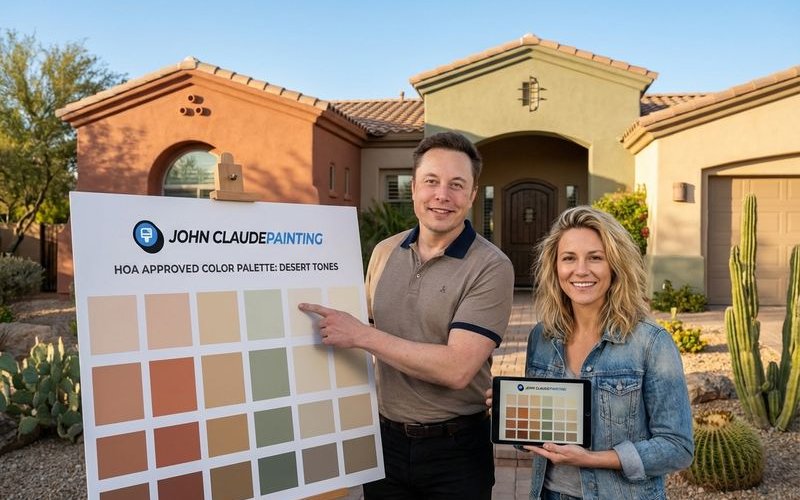
Arizona HOAs approve colors that blend with the Sonoran landscape. In 2026, we see a shift toward “greige” and warmer, modern earth tones.
- Dunn-Edwards Favorites: Colors like “Nomadic Desert” (DE6192) or the 2026 trending “Country Air” (DET581) for a modern feel.
- Sherwin-Williams Staples: “Accessible Beige” (SW 7036) and “Dovetail” (SW 7018) are incredibly popular in Gilbert and Chandler.
- Natural Accents: Muted terracottas and soft sage greens (like “Desert Turtle”) are replacing the bright turquoises of the past.
Colors Often Restricted
- High LRV Whites: Pure white is blinding in the Arizona sun. Most HOAs cap LRV at 85.
- Primary Brights: No fire engine reds or lemon yellows.
- Black: While trendy for trim, expansive black walls absorb too much heat, leading to premature stucco failure.
- Non-Native Blues: Unless it’s a specific “Santa Fe” style door, bright blues are usually rejected.
Updating Color Palettes
HOA color palettes should be reviewed every 5-7 years.
- Trends Evolve: That “Tuscan Gold” from 2005 dates your community instantly.
- New Technologies: Modern pigments resist UV fading better.
- Community Preference: A modern palette can actually increase home values in the neighborhood.
- Consult a Color Expert: Many paint manufacturers offer free color consulting to HOAs to update their books.
Maintenance Standards
Triggering Conditions
Most HOAs require repainting when:
- Stucco Cracks: Even hairline cracks allow moisture to rust the wire mesh underneath (called “cancer” in the trade).
- Foundation Exposure: Soil erosion exposing the concrete stem wall (which should be painted).
- Wood Rot: Fascia boards that look “alligator-skinned” or peeling.
- Metal Oxidation: Wrought iron gates showing rust spots.
Reasonable Timelines
Arizona courts have generally supported a process that gives owners a fair chance to comply.
- First Notice: Courtesy letter (0 fines).
- Second Notice: Violation letter (potential fine warning).
- Fine Hearing: Under ARS §33-1803, you must offer the homeowner a hearing before levying a fine.
- Timeline: 30-60 days is standard to allow for contractor scheduling.
Enforcement Best Practices
- Consistency is King: You cannot fine House A for fading if House B is worse and gets ignored.
- Photo Evidence: Take dated photos of the violation for the file.
- Written Documentation: Keep a log of every letter and email.
- Appeal Process: Make it clear how a homeowner can dispute the finding.
Working with Contractors
Selecting HOA Painting Contractors
For community-wide projects, this is a high-stakes decision. You need a partner, not just a painter.
- Check the License: Go to the Arizona Registrar of Contractors (ROC) website. Look for a C-34 (Commercial) or CR-34 (Dual) license. An R-34 license is for residential only and may not cover large common areas.
- Insurance: Verify they have General Liability and Workers’ Comp. If a worker falls off a ladder on your common area, the HOA could be liable without this.
- Experience: Ask for a list of 3 other HOAs they have painted in the last year. Call those references.
- Communication: Do they have a plan to notify residents about parking restrictions?
Insurance Requirements
Most HOAs require contractors to carry:
- General Liability: $1 million per occurrence / $2 million aggregate is the standard minimum.
- Workers’ Compensation: Mandatory in Arizona.
- Auto Liability: For the trucks driving through your streets.
- Additional Insured: The certificate must name the HOA and the Management Company as “Additional Insured.”
Contract Considerations
- Detailed Scope: Define exactly what “prep” means. (e.g., “Trenching 4 inches below grade” vs just “painting to grade”).
- Warranty: Look for a 5-7 year warranty on labor and materials.
- Payment Schedule: Never pay 100% upfront. A standard is 10-30% down, progress payments, and a final retention.
- Cleanup: Specify that the site must be cleaned daily.
Budget Planning
Reserve Fund Considerations
Painting is a “Reserve Component.”
- Cycle: Plan for a 7-10 year repainting cycle for stucco.
- Wood/Iron: These need attention every 3-5 years (much sooner than stucco).
- Inflation: Paint material costs have risen sharply. Adjust your reserve study annually.
Cost Factors for HOA Painting
| Factor | Impact | 2026 Estimated Cost (Phoenix) |
|---|---|---|
| Basic Repaint | Standard stucco body & trim | $2.00 - $3.50 per sq. ft. |
| High Prep | Extensive crack repair/peeling | $3.50 - $4.50+ per sq. ft. |
| Access | Multi-story or difficult terrain | +15-25% surcharge |
| Color Change | Drastic shift (e.g., dark to light) | Requires 2nd body coat (+30-50%) |
| Wrought Iron | Fencing and gates | $8 - $12 per linear ft. |
Phased Approach
If the reserve fund is low, consider phasing.
- Year 1: Perimeter Walls (most visible).
- Year 2: Community Center & Pool.
- Year 3-5: Residential units (if HOA maintained) broken by street.
Arizona-Specific Considerations
Climate Challenges
Arizona painting is an extreme sport.
- UV Radiation: The sun destroys cheap paint binders. You need 100% Acrylic high-quality paint (like Dunn-Edwards EverShield or Sherwin-Williams Latitude).
- Monsoons: High humidity in July-August can cause “blushing” or poor adhesion if paint is applied right before a storm.
- Heat: Do not paint if the surface temperature is over 90-100°F. The paint “flashes” (dries) too fast and won’t bond.
Best Painting Seasons
- Prime Time: October - April. This is when the weather is stable.
- Shoulder Season: May and June (start early in the morning).
- Avoid: July, August, and September afternoons (Monsoon risk).
Common Arizona HOA Issues
- Stucco Cracking: Thermal shock from hot days and cool nights causes hairline cracks.
- Efflorescence: White, salty deposits on walls near sprinklers. This must be treated with acid/vinegar before painting or it will burn through.
- Stem Wall Issues: Post-tension slabs often have exposed concrete that gets ugly if not painted and waterproofed.
Legal Considerations
Fair Housing Compliance
Painting requirements must be uniform.
- No Discrimination: You cannot enforce strict rules on one protected class while letting others slide.
- Disability: If a resident needs a modification (like a ramp), the HOA can require it to be painted to match the home, but they cannot deny the ramp itself.
Enforcement Limitations
Arizona law protects homeowners from tyranny.
- Due Process: You cannot fine without notice and an opportunity to be heard (ARS §33-1803).
- Reasonableness: Fines must be reasonable ($15-$25 for a first offense is typical; $500 is likely not).
- Appeal Rights: Residents have the right to appeal to the Arizona Department of Real Estate if they feel the HOA is violating statutes.
Documentation Importance
- Violation Log: Keep a spreadsheet of who was notified and when.
- Certified Mail: Use it for the final violation notice before fines start.
- Architectural Requests: Keep these on file permanently. They are proof of approval for future owners.
Best Practices for Property Managers
Proactive Communication
Send a “Spring Painting Reminders” email blast in February. Remind people that ARC approval takes time, so they should apply early.
Consistent Standards
Walk the property with the Board once a quarter. Agree on what a “violation” looks like so everyone is on the same page.
Vendor Relationships
Building a relationship with a reliable painter (like John Claude Painting) means you have someone to call for quick graffiti removal or emergency gate repairs, not just the big jobs.
Our HOA Experience
At John Claude Painting, we’ve partnered with property managers across the Valley since 2005 to streamline community maintenance. We know that a fresh coat of paint does more than protect stucco; it revitalizes community pride and property values.
Our team specializes in:
- Reserve Study Consulting: Helping you budget accurately for future cycles.
- Color Rendering: Showing your board exactly what that new palette will look like.
- Resident Communication: We handle the notices and scheduling so you don’t have to.
- Compliance: Fully licensed (ROC #) and insured for large-scale HOA projects.
We provide free community assessments to identify critical repair needs before they become expensive failures.
Contact us to discuss your HOA’s painting needs. Our commercial painting services include HOA and multi-unit residential projects.
Topics:
Found this helpful?
Share this article with friends or neighbors who might benefit from these insights.